
What you will learn in this article
How to visit a Shinto shrine in Japan, step by step, and why each step is done.
To make the meaning easier to grasp, I will compare each custom with similar ideas in Christianity, Islam, Judaism, Buddhism and Hinduism.
They are never exactly the same, and I will point out the differences too.
But a familiar idea is often the best door into an unfamiliar one.
Hello! I am Makomo, and I write about Japanese myths, kami (Shinto deities) and shrines on this blog.
This article is the English version of my Japanese guide to shrine etiquette, rewritten for readers from outside Japan.
Visiting a shrine, in one sentence
It means cleansing your body and mind, and then greeting the kami.
The etiquette is simply a “form” for doing that.
The Association of Shinto Shrines (Jinja Honchō), which oversees most shrines in Japan, explains that the most important thing in visiting is to purify your body and mind.
The outward form helps settle the inner heart.
Let’s go through the steps with that in mind.
First: what is a kami?
Before the steps, a quick note on who you are greeting.
A kami is a sacred presence in Shinto.
Kami include the gods of the Japanese myths, such as the sun goddess Amaterasu.
They also include the powers of nature, such as a mountain, a great tree or a waterfall, and even people who were honored after death, such as Emperor Meiji at Meiji Jingu in Tokyo.
Japanese people traditionally speak of “yaoyorozu no kami”, the “eight million kami”, meaning countless kami.
Here is how kami compare with ideas you may know:
- Christianity, Islam and Judaism believe in one almighty Creator God. Kami are not like that. No single kami is almighty, and Shinto has no creed you must accept. A kami is closer to a sacred presence that lives in a particular place.
- Catholic and Orthodox Christianity honor saints, holy people of the past, and many churches are dedicated to a particular saint. A shrine dedicated to a person who became a kami can feel somewhat similar, although Shinto does not distinguish between “God” and “saints” in that way.
- Hinduism knows many devas and devis, often worshipped in their own temples and linked to rivers and mountains. Of all five, this may feel the closest to kami.
- Buddhism in Japan lived side by side with Shinto for over a thousand years. Buddhas are honored in temples, and kami are honored in shrines. Many Japanese visit both.
Shinto also has no single founder and no holy book like the Bible, the Qur’an or the Torah.
The old chronicles *Kojiki* (712) and *Nihon Shoki* (720) tell the myths of the kami, but they are not read as commandments.
The basic steps of a shrine visit
1. Bow once before the torii gate
The torii is the gate that marks the boundary between our everyday world and the sacred space of the kami.
It is customary to stop in front of the torii and make a light bow before passing through.
It is just like saying “excuse me” when you step into someone’s home.
Similar ideas in other faiths
- Christianity: many Christians grow quiet when they step through the church door, and Catholics may make the sign of the cross.
- Islam: you take off your shoes at the entrance of a mosque, which marks the line between outside and the place of prayer.
- Judaism: the mezuzah fixed on a doorpost marks a doorway, and many Jews touch it as they pass through.
- Hinduism: large temples in South India have a tall gate tower called a gopuram that marks the entrance to the sacred area.
- Buddhism: temples in Japan have a great gate called a sanmon, and people often bow there too.
2. Walk along the side of the approach path (one of several theories)
At many shrines, the center of the approach path (sandō) is called seichū and is said to be the path of the kami.
So it is considered polite to walk a step to the left or right of the center.
This is a popular custom, not an official rule of every shrine, and views differ between shrines.
There is also a theory that you should lower your head slightly when you cross the center.
Many old shrines are surrounded by a sacred forest called chinju no mori, where the kami are believed to dwell.
Please do not take any branches, leaves or plants home.
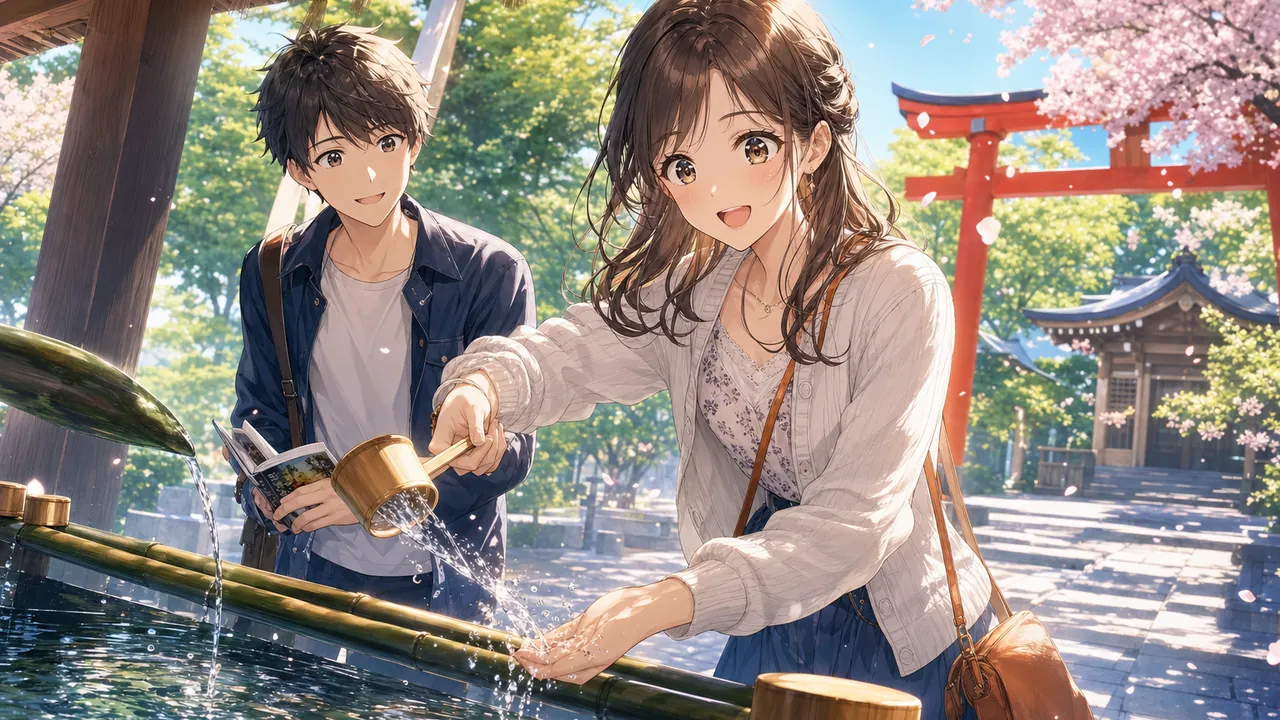
3. Purify yourself at the temizuya
Before approaching the main hall, you wash your hands and rinse your mouth at the water basin, the temizuya.
Here are the steps, as introduced by the Association of Shinto Shrines:
1. Take the ladle in your right hand and pour water over your left hand.
2. Move the ladle to your left hand and pour water over your right hand.
3. Move it back to your right hand, pour a little water into your cupped left hand, and rinse your mouth with it.
Never put the ladle directly to your mouth, and do not swallow the water; spit it out quietly to the side.
Many guides add a final step: wash your left hand once more, then tilt the ladle upright so the remaining water runs down the handle, and put it back.
Temizu is said to be a simple form of misogi, purification by bathing in the sea or a river.
In the *Kojiki*, the god Izanagi returns from the land of the dead and washes himself in a river.
At the temizuya, we receive that same cleansing power of water with just our hands and mouth.
Similar ideas in other faiths
- Islam: wudu, the washing of the hands, mouth, face and feet before prayer, is probably the closest practice of all. If you are Muslim, temizu may feel very familiar.
- Judaism: netilat yadayim, the ritual washing of the hands with a cup before eating bread and on other occasions, is also very close in spirit.
- Christianity: in Catholic and Orthodox churches, people dip their fingers in holy water at the entrance, a reminder of baptism.
- Hinduism: worshippers wash their hands and feet before entering a temple, and bathing in sacred rivers such as the Ganges is a form of purification.
- Buddhism: temples in Japan also have a water basin, and the way of washing is much the same.
An important difference: impurity is not sin
The impurity that Shinto cleanses is called kegare.
It is not “sin” in the Christian sense, a moral wrong against God.
It is more like a stain or a lowering of life energy, which comes from contact with death, illness or misfortune, and which water and rites can wash away.
In this sense, kegare is closer to the Jewish idea of ritual impurity (tumah), or the Islamic rules of ritual purity before prayer, than to the idea of sin.
4. Make an offering
When you reach the hall of worship (haiden), quietly drop a coin into the offering box.
Long ago, this offering was rice, not money.
People wrapped freshly harvested rice in white paper and offered it to the kami in gratitude for the harvest.
As money spread, coins took the place of rice.
Meiji Jingu’s own guide explains that putting money into the offering box is a relatively new custom at shrines (Japan Tourism Agency multilingual explanation database, Meiji Jingu).
So the offering is not a “fee” for your wish. It is a sign of thanks.
There is no set amount.
In Japan you will often hear that a 5-yen coin is lucky, because “go-en” (5 yen) sounds like the word for “a good connection”.
This is just a pun, not a rule of the shrine, so please enjoy it as a bit of fun.
Please do not throw the coin. Place or drop it in gently.
Similar ideas in other faiths
- Christianity: the collection plate at church, which is also given in gratitude rather than as payment.
- Islam: sadaqah, voluntary giving, is also done in gratitude to God, although it usually goes to people in need rather than to a place.
- Judaism: tzedakah, giving to charity, is a central practice, and many synagogues have a box for it.
- Hinduism: worshippers offer flowers, fruit and coins in the temple. Like the rice of old Japan, this begins with offering the gifts of nature.
- Buddhism: giving (dāna) is one of the basic Buddhist virtues, and temples in Japan also have offering boxes.
5. Ring the bell
At shrines that have a bell above the offering box, ring it by shaking the rope.
There are several theories about its meaning: to let the kami know you have come, or to purify the place and yourself with its clear sound.
None of them is an official definition.
Similar ideas in other faiths
- Hinduism: this is strikingly similar. Many worshippers ring a bell (ghanta) when they enter a Hindu temple, and it is often explained as announcing one’s presence to the deity.
- Christianity: church bells call people to worship.
- Buddhism: temples in Japan have large bells, and some halls have a gong that visitors strike before praying.
6. Two bows, two claps, one bow
Now comes the prayer itself.
The basic form, according to the Association of Shinto Shrines, is “two bows, two claps, one bow” (nihai nihakushu ippai):
1. Stand up straight and bow deeply twice, bending at the waist to about 90 degrees.
2. Bring your hands together at chest height, slide your right hand down slightly, and clap twice.
3. Put your hands back together and pray from your heart.
4. Finally, bow deeply once more.
The clap is called kashiwade.
The Association explains that the name comes from the leaf of the kashiwa (oak), because the hands are struck together with the fingers neatly aligned, like the shape of the leaf.
Similar ideas in other faiths
- Bowing: Muslims bow (ruku) and prostrate (sujud) in daily prayer, Jews bow at certain points of the Amidah prayer, and Catholics genuflect before the altar. Hindus greet the gods with folded hands (namaste or pranam), and Buddhists join their palms (gasshō).
- Clapping: this is something rarely found in other religions. It has a long history, though. A 3rd-century Chinese record about the people of Japan, the “Account of the Wa” in the *Records of the Three Kingdoms*, says: “When they show respect to a person of high rank, they simply clap their hands, in place of kneeling and bowing.” In ancient Japan, clapping seems to have been a way of showing deep respect.
Note: do not clap at Buddhist temples.
At a Buddhist temple, you usually just join your palms quietly.
Clapping is for shrines.
If you see a torii, you are at a shrine; if you see incense burners and statues of the Buddha, you are probably at a temple.
7. Bow once more on your way out
When you leave through the torii, it is customary to turn around and bow once toward the shrine.
It is your “thank you for having me”.
Some shrines do it differently
“Two bows, two claps, one bow” is the standard form, and it became common across Japan only from the late 19th century, after the Meiji government set out shrine rituals in 1875 and later.
Before that, styles of worship varied from shrine to shrine and region to region.
Even today, some shrines keep their own form:
- Izumo Taisha (Shimane): two bows, four claps, one bow. At its annual festival on May 14, eight claps are used.
- Usa Jingu (Oita): two bows, four claps, one bow.
- Yahiko Jinja (Niigata): two bows, four claps, one bow.
- Ise Jingu (Mie): priests use a special form with eight bows and eight claps at important ceremonies, but ordinary visitors pray with two bows, two claps and one bow.
Why four claps? No official explanation could be found, and there are several theories.
If a shrine shows its own way of praying, simply follow it.
The heart of it: gratitude first
Many people think of shrines as places to ask for wishes, such as passing an exam or finding love.
But just as the offering began as thanks for the harvest, a shrine visit is basically about gratitude.
“Thank you for keeping me safe and well until today.”
Starting with words like these is the traditional spirit.
You may also ask for something, of course, and many people add a promise to do their best.
Gratitude before requests is something that every tradition in this article shares:
the Christian prayer of thanksgiving, the Islamic “alhamdulillah” (praise be to God), the Jewish blessings said throughout the day, the Hindu offering of the first fruits, and the Buddhist practice of gratitude.
Shinto also has an old ideal called kiyoki akaki kokoro, “a pure and bright heart”: a heart with no lies or clouds in it.
Washing at the temizuya and bowing at the torii are all ways of standing before the kami with that heart.
Other things you may see
Ema (votive tablets)
Ema are small wooden plaques on which people write their wishes and hang them at the shrine.
Japanese visitors often write their wishes in Japanese, but you are welcome to write in your own language.
If you have ever seen the Western Wall in Jerusalem, where visitors tuck written prayers into the cracks between the stones, you already know the feeling of an ema.
Lighting a candle for a prayer intention in a Catholic church also comes from a similar heart.
Omamori (amulets) and ofuda (talismans)
Omamori are small charms in cloth bags, each with a purpose such as safe travel, health or study.
Ofuda are paper or wooden talismans that people enshrine at home.
They may remind you of the medals of saints that some Catholics wear, or the sacred red thread that Hindus tie around the wrist after a ritual.
It is common to return old ones to the shrine after about a year, where they are respectfully burned.
Goshuin (shrine seal stamps)
A goshuin is a seal and brushed calligraphy that a shrine writes in your special book as a record of your visit.
It is not a tourist stamp. Please pray first, then ask for it.
“I am not Shinto. Can I visit?”
Yes. Shinto has no conversion ritual and no creed, and almost all shrines welcome visitors of any faith, or of none.
Most Japanese people do not think of themselves as belonging only to Shinto either; many also have Buddhist funerals and celebrate Christmas.
At the same time, I understand that some of you may feel that bowing or praying before a kami does not fit your own faith.
In particular, Islam and Judaism, and many Christians, hold that worship belongs to the one God alone.
If that is your case, it is perfectly fine to:
- Simply walk around the grounds respectfully as a guest, and admire the architecture and the forest.
- Make a light bow as a greeting, in the same way Japanese people bow to each other, if you feel comfortable.
- Skip the clapping and the prayer altogether.
Nobody at the shrine will think you rude.
What matters is the respect you show for a place that is precious to others.
How far you take part is for you and your own faith to decide.
Common questions about manners
What if someone in my family has just died?
In Shinto, the period of mourning after a death is traditionally fifty days, and it is common to avoid visiting shrines during that time.
This is because death is linked to kegare, the impurity we discussed above.
You may find this similar to shiva, the Jewish seven days of mourning followed by a longer period, during which mourners stay away from certain activities.
If you are unsure, it is best to ask the shrine.
Can I take photos?
At most shrines, you can take photos of the grounds.
However, many shrines ask visitors not to take photos at the place where people pray.
Meiji Jingu, for example, asks visitors not to take photos or videos at the main sanctuary.
Please also take care not to photograph people while they are praying.
A Shinto way of seeing it
Every Shinto festival begins with harae, purification.
Impurity is washed away first, and only then are the kami welcomed.
A shrine visit has the same shape.
You cross the boundary at the torii, purify yourself at the water, and then stand before the kami.
In a way, each visit is a small festival of your own.
Makomo’s Thoughts
These are my own thoughts, Makomo’s.
While writing this article, what struck me most was how much shrine etiquette resembles the manners of visiting someone’s home.
You say “excuse me” at the door.
You wash your hands before you come in.
You bring a small gift and say thank you.
And when you leave, you say “thank you for having me”.
I think shrine etiquette was born from a Japanese feeling that the kami are not distant beings, but respected neighbors living close by.
That is also why I tried comparing it with other religions.
Washing before prayer, giving in gratitude, writing a prayer and leaving it in a holy place.
People in very different parts of the world came up with very similar ways to show respect to what is sacred.
I find that rather moving.
So please do not worry too much about making mistakes.
If a child visiting a friend’s house for the first time is a little clumsy but tries hard to greet everyone politely, that feeling surely gets through.
By the way, “use only one ladle of water for everything” is surprisingly hard.
If you pour too much on your left hand at the start, there is nothing left for your right hand and your mouth.
…In that case, I think it is fine to scoop once more.
Shrines in anime and films
Many shrines in Japan have appeared in anime and films, and fans travel to visit them.
In Japan, this is called seichi junrei, a “pilgrimage to the sacred places” of a story.
- *Spirited Away* (2001, film): Studio Ghibli’s film is set in a bathhouse where countless kami come to rest, a good picture of the “eight million kami”.
- *Lucky Star* (2007, anime): Washinomiya Shrine in Kuki, Saitama appears under the name “Takamiya Shrine”, and the twin sisters Kagami and Tsukasa are the daughters of the shrine’s family. After the series aired, the number of New Year visitors to the shrine grew greatly, according to news reports.
- *Love Live!* (2013, anime): Kanda Myojin in Tokyo is the model for the shrine where the character Nozomi Tojo helps out. The shrine has held collaborations with the series, such as special ema and goshuin books.
- *Your Name.* (2016, film): the stairs of Suga Shrine in Shinjuku, Tokyo are known as the model for the film’s final scene.
Even on a pilgrimage for your favorite story, the shrine is still the home of the kami.
Pray first, then take photos.
Please do not point your camera at people praying, or at priests and shrine maidens (miko).
A little care like this protects both the work you love and the shrine.
Summary
- A shrine visit means cleansing your body and mind, then greeting the kami.
- The basic flow is bow at the torii → walk to the side of the path → purify at the temizuya → offering → bell → two bows, two claps, one bow.
- Temizu is close in spirit to Islamic wudu, Jewish hand-washing and Catholic holy water.
- The offering began as rice given in thanks for the harvest. There is no set amount.
- Clapping is a very old Japanese way of showing respect, but do not clap at Buddhist temples.
- Some shrines, such as Izumo Taisha, Usa Jingu and Yahiko Jinja, use four claps.
- Visitors of any faith, or none, are welcome, and you may take part only as far as you feel comfortable.
The etiquette is a form for settling the heart.
Once you know the form, simply greet the kami with gratitude, or simply enjoy the quiet of the forest as a respectful guest.
For readers of Japanese, the Japanese version of this article is here: 神社参拝の作法と心がまえ
FAQ
Q. Can non-Japanese people visit Shinto shrines?
A. Yes. Almost all shrines welcome visitors from any country and of any faith.
Q. Do I have to pray if I visit a shrine?
A. No. You are welcome to visit simply as a respectful guest.
Q. What is the difference between a shrine and a temple?
A. Shrines (jinja) honor the kami of Shinto and usually have a torii gate. Temples (tera) honor the Buddha and often have incense burners. You clap at shrines, but not at temples.
Q. What if there is no water or no ladle at the temizuya?
A. Just purify yourself in your heart and go ahead. Some shrines removed their ladles as a measure against infection.
Q. How much money should I offer?
A. There is no set amount. The offering is a sign of thanks, and its value does not depend on how much you give.
This article is based on the Japanese classics such as the *Kojiki* and *Nihon Shoki*, and on materials available online, with Makomo’s own thoughts added. My own interpretations are kept separate in the section “Makomo’s Thoughts”.

コメント